Clients & Accounts
Client tier, owner, contract value, projects, MRR and links — one operational home per account.
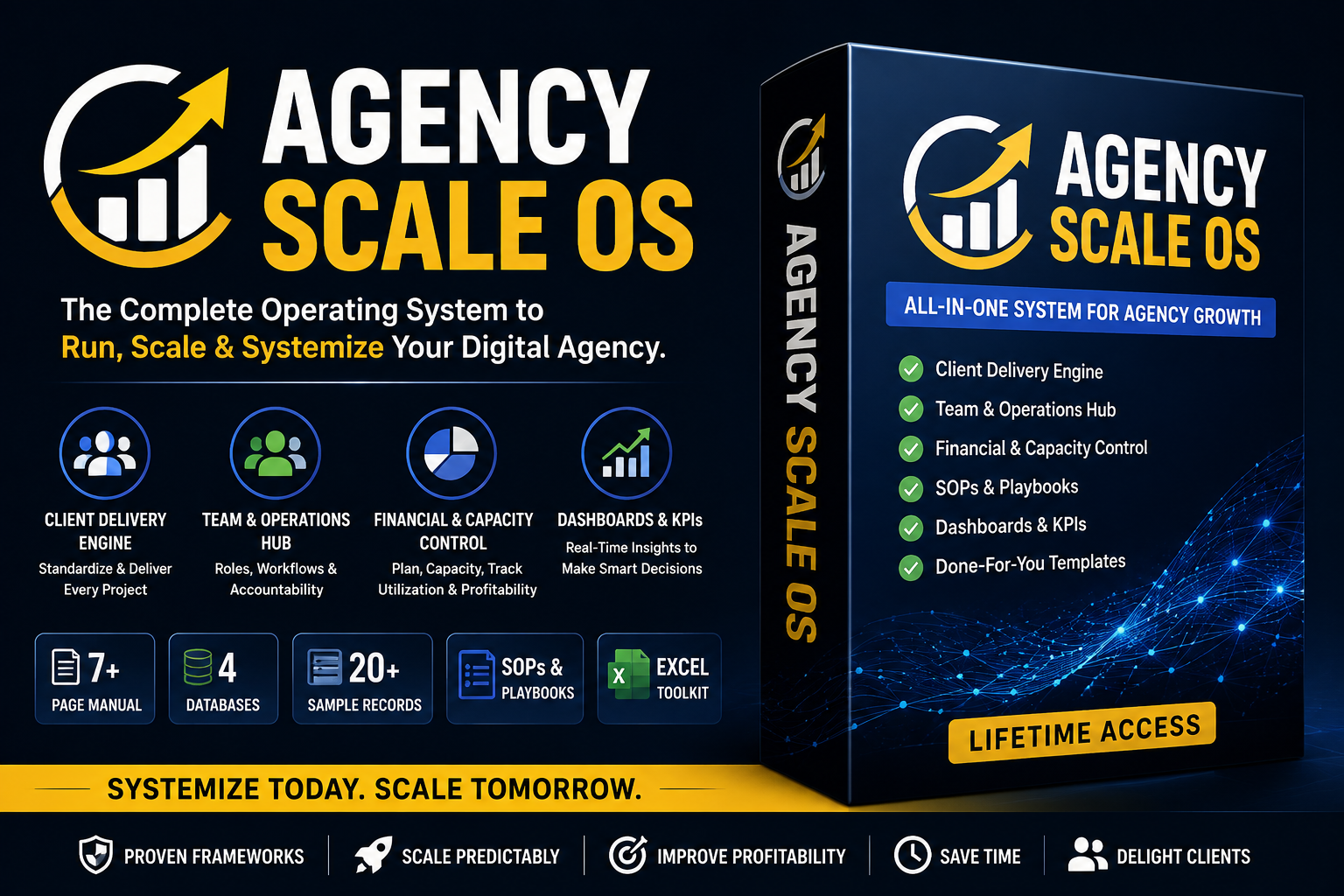
Agency Scale OS turns client commitments, sprint delivery, SOP ownership and team capacity into one structured Notion command center — so problems become visible before clients feel them.


As your client roster and team grow, invisible exceptions start compounding: unpriced scope, undocumented decisions, guessed capacity and ownerless process.
Small requests become unplanned work before somebody prices the change.
Overload is discovered after deadlines begin moving.
Quality depends on memory instead of a shared gate.
Process exists, but ownership and execution are disconnected.
One client requires checking messages, boards, sheets and several people.
Client context, execution, process and capacity are designed to inform each other.
Client tier, owner, contract value, projects, MRR and links — one operational home per account.
Assignee, priority, deadline, billable hours, sprint status and variance across accounts.
Department, owner, review cycle, verification and linked deliverables.
Weekly capacity, assigned hours, utilization and availability — visible before assignment.
The numbers behind staffing decisions, utilization and hiring warnings.
Change-request framework, billing triggers and client-facing scope messages.
MRR, margin, utilization, client health and SOP compliance visibility.
Instant access · Lifetime updates · 7-day refund

The value is the relational architecture, formulas, views and runbooks — not access to Notion itself.
Keep them if they work. Agency Scale OS can act as the leadership layer for clients, capacity, SOPs and operating visibility.
Yes. It is organized around shared client-service operations rather than one specific marketing channel.
No advanced coding is required. The product specifies the structure, logic and deployment sequence.
The initial deployment path is designed for roughly 45 minutes when your operating data is ready.
Yes. Adapt naming, departments, services and internal process while keeping the relational architecture.
Put client context, delivery, capacity and SOP ownership into one operating system your team can actually run.
Get the complete system